


Exhibition Foreword

Situated at the intersection of computational art and planetary elements, Liu Jiayu’s immersive practice presents an inversion of the sensible. The exhibition Still, Life (双曜 ), marking her first major institutional solo worldwide, turns digital aesthetics inside out: air, wind, waves, marine life, and quantum fluctuations become living matter for deep learning. Within her practice, computation operates as a method for studying nature - much as Chinese landscape painting once did - yet Liu pushes her premise toward an inverted question: can studying nature help us understand computation?
The exhibition carries two worlds within it, investigating the proximity, difference, mirroring, and doubling of nature and computing. In Still, Life, computation and intelligence are treated as environmental processes rather than being sealed inside machine simulations. Tracing real-time patterns from sky to sea, pushes beyond conventional notions of artificial intelligence, as Liu tracks connections between recurring patterns and unpredictable moments in nature as well as language, culture, and perception.
The title Still, Life (双曜 ) encapsulates a dialectic between stillness and movement, articulated as a dialogue across the dual worlds. A synthetic white surface contrasts with the pulsating weather and marine life that become sculptural vector forms. A quiet murmur of life runs through the installations, manifesting an elemental aesthetics in which the planetary energies and matter of metal, wood, water, fire, and earth are expressed through art and technology. Here, language and cognition emerge as new planetary synthetic elements - media through which existing worlds are doubled and regenerated.
The exhibition unfolds across two overlapping spatial regimes, connected by a multitude of surfaces that act like membranes. The first chapter explores computational modelling and environmental sensing as artistic methods, while also building on legacies of abstract art. Just as the brushstroke in traditional painting is a trained movement, Liu stages how learning and rehearsal animate computational landscapes into immersive environments. Her synthetic worlds speculate on novel forms of cognition and artificial realities, yet remain embedded in the Earth’s circulatory processes. The synthetic is not opposed to the natural; rather, the entire encounter is built upon the centrality of connection and relation - as expressed in the character shuāng (双 ).
These elemental media and aesthetics reappear in the other major chapter of the exhibition, where large installations lend an architectural presence to liquid surfaces and celestial light, articulated as synthetic life. A garden becomes the site of multispecies computational life; liquid surfaces turn into flickering screens; a pond, a sea, an ocean, and a garden together become part of rituals of contemplation. This synthetic ecology is entirely real and felt as light - as yào (曜 ) signifies.
—— Jussi Parikka
Exhibition Walkthrough Film
双曜 / Still, Life
At 798CUBE in Beijing, light moves across architectural structures, an artificial sky unfolds upon water, and electromagnetic signals become shifting constellations of illuminated points. These are not representations of nature in any conventional sense. They emerge from systems that sense, process, and reorganise information about the world. Bringing together eleven works produced between 2014 and 2026, Liu Jiayu’s solo exhibition Still, Life, curated by media theorist Jussi Parikka, examines how computation shapes our experience of nature—and how natural processes might, in turn, offer new ways of understanding computation itself.
Rather than tracing a chronological development, the exhibition brings works from different periods into a continuous spatial landscape. Wind, water, light, sound, and living organisms appear not simply as subjects but as active elements within computational processes. For Jiayu, whose practice has developed from sensor-based installations to machine learning and artificial intelligence, the central concern is but how computation can reveal and open up worlds beyond the limits of human perception, while exploring how machines themselves perceive and make sense of the world.
Curated by Jussi Parikka
Art and Technology Advisor: Frederic Fol Leymarie
25 September 2026 – 31 March 2027
Opening Highlights
Video by ARTnews China, 2026
The exhibition’s title articulates this reciprocal movement. The comma in Still, Life interrupts the familiar art-historical category of still life, suggesting that apparent stillness may contain ongoing processes of transformation. Its Chinese title, Shuang Yao (双曜 ), evokes two celestial bodies illuminating one another. Nature and computation are presented neither as opposing domains nor as elements of a seamless technological synthesis, but as distinct systems whose interactions enable new forms of perception.
Parikka’s curatorial framework also draws upon traditional Chinese landscape painting, understood not simply as the depiction of scenery but as a practice of observing and learning from nature through embodied gestures. Jiayu’s computational landscapes similarly emerge through processes of sensing, training, and generation. The connection is methodological rather than stylistic: both approaches consider artistic form as a way of investigating the world, rather than merely reproducing its appearance.
KERING - Women in motion - Interview
The exhibition opens with White Surface (2026), which takes Kazimir Malevich’s White on White (1918) as its point of departure, revisiting a fundamental question about images and perception: if Malevich explored the boundaries of painting through white over a century ago, how does artificial intelligence understand and generate white today? Jiayu begins by asking generative AI to produce a pure white image, before translating its subtle variations, almost imperceptible to the human eye, into material traces through a nineteenth-century iron-silver photographic process. What initially appears blank gradually reveals faint variations of grey and particles of metallic silver upon closer inspection. By bringing computational image generation into contact with photographic chemistry, the work stages an encounter between two distinct systems of image production, each governed by its own processes. The question is not only how machines understand white, but also where an image begins and ends when its production unfolds across computational and material processes.
White Surface
AI-generated images, kallitype prints, aluminium
80cm x 80cm x 10cm x 4

In Sailing (2026), invisible electromagnetic activity detected within the exhibition space is translated into high-dimensional vectors and organised through a computational model into a changing structure of light. Signals emitted by visitors’ electronic devices become part of the work’s ongoing transformations. The installation makes perceptible a form of informational space increasingly central to contemporary machine learning: one in which relationships are organised through vectors rather than through images or language directly accessible to human perception. What appears as a field of moving light also explores how machines navigate information.
Sailing
Galvanised square steel tubing, acrylic, LED light strips, custom model developed in Python
*Real-time data stream from electromagnetic activity in the exhibition space
708cm x 400cm x 220cm x 3


Living Shell (2025–2026) shifts the investigation towards artificial life. Using Neural Cellular Automata informed by natural shell patterns, the work incorporates real-time environmental parameters from an aquatic system into the evolution of its cellular structures. Changes in oxygen levels, temperature, light, and pH influence both the system’s states and its generative rules. Rather than simulating a predetermined living form, the installation establishes conditions for a computational process that continually responds to its surroundings. The environment becomes part of the system’s operation rather than an external source of data.
Living Shell
Stainless steel, curved LED modules, low-power microcontrollers, sensor system, cellular automata, custom model developed in Python
*Real-time data stream from the water tank
400cm x 220cm x 300cm

Together, these works approach computation through image, information, and life. Their significance lies not in the complexity of the technologies employed but in the different ways they redistribute the relationship between artistic intention, computational processes, and material conditions.
Elsewhere, works from earlier periods establish a longer trajectory for these questions. Within Invisibility (2014), Jiayu’s graduation work from the Royal College of Art, compresses six hours of wind data collected from forty Chinese cities into six seconds of physical airflow. The installation transforms geographically dispersed meteorological information into a bodily encounter, reorganising the scales of space and time through which natural phenomena can be experienced. A decade later, Celestial Notes (2024) turns towards communication between machines. Developed using Jiayu*, Jiayu’s self-trained artificial intelligence system, the work brings together language, images, and the sounds of early internet communication, raising questions about forms of exchange that remain unintelligible to human listeners.
Celestial Notes
4'58" looped
Custom display, speakers, painted stainless steel, custom sound generation model
Within Invisibility
Acrylic, custom flexible electronic fans, servo motors, microcontrollers, ABS
*Wind speed and direction data from 40 cities in China, 2012-2013
320cm x 150cm x 200cm


The exhibition’s second spatial chapter moves through water, light, and synthetic ecologies. In The Side Valley (2018), machine-generated skies are projected onto a liquid surface, returning computationally reconstructed nature to a physical environment. Waves of Code (2023) transforms oceanographic data through successive stages of computation into a luminous, architectural-scale seascape composed of 221 LED strips and mirrored surfaces. The resulting ocean is neither a direct simulation nor a conventional visualisation of data, but a landscape produced through the machine’s processing and reconstruction of natural movement.
The Side Valley
Stainless steel, translucent liquid, high-density polyethylene(HDPE) membrane, generative adversarial network (GAN)
*Real-time data stream from wind data collected in the Vallée de Joux, Switzerland
1126cm x 11cm x 361cm
Wave of Code
8'30" looped
Acrylic, LED light strips, mirrored glass, AI-generated p5.js code
1785cm x 480cm x 575cm


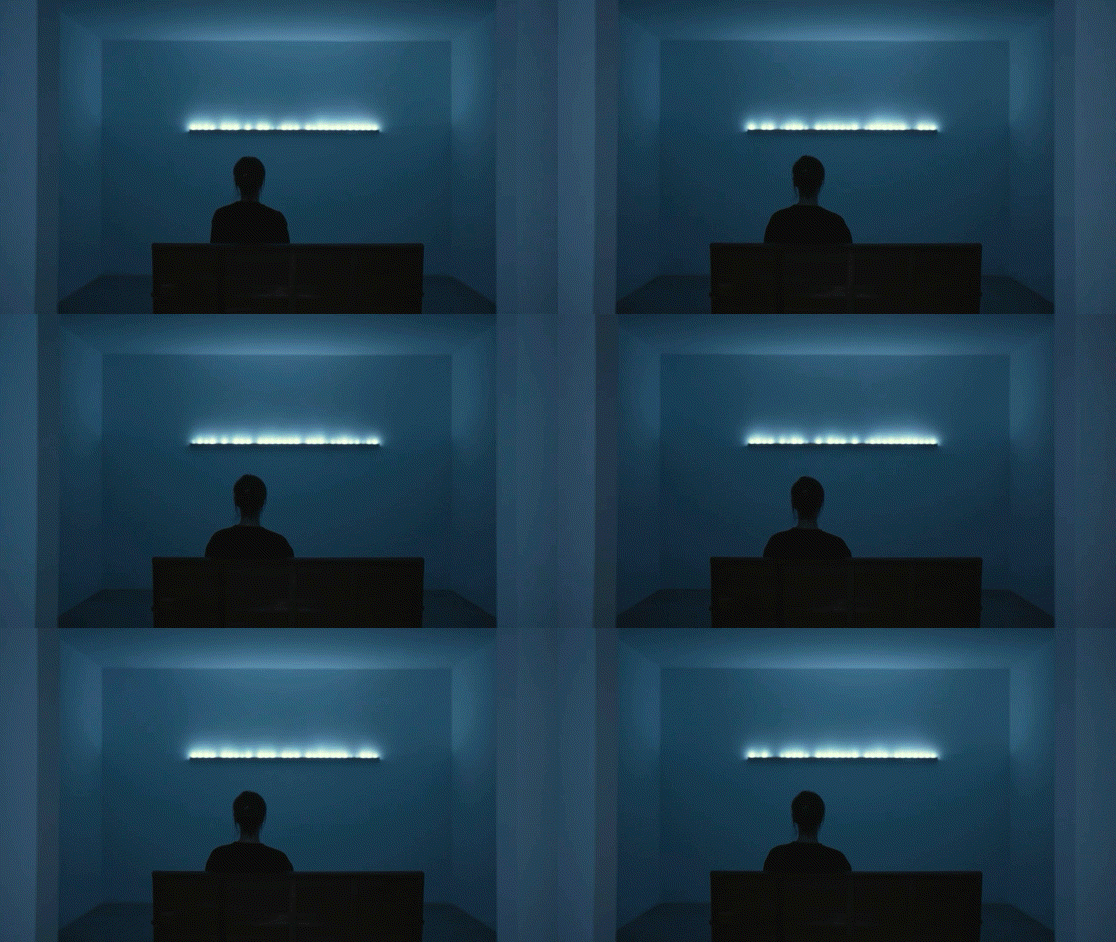
At a smaller scale, Murmur (2026) translates quantum randomness into subtle fluctuations of light within an intimate, chapel-like space. Its unpredictable flickering evokes the movement of candle flames, allowing microscopic physical uncertainty to encounter human associations of memory, hope, and the unknown. The work does not assign meaning to randomness itself; rather, it creates a situation in which viewers may find meaning in what cannot be anticipated or repeated.
Murmur
Stainless steel, LED light strips, church pews
*Real-time data stream from quantum random numbers generated by the Australian National University Quantum Random Number Generator (QRNG)
200cm x 15cm x 2cm
The Still Garden series extends these investigations into the relationships between computation and living systems. In Still Garden #2, the physiological responses of marine organisms and ocean temperature data inform the generative processes of Jiayu*, producing an imagined underwater ecology shaped by environmental conditions. Still Garden #3 brings machine-generated organic forms into physical space through sculptural structures incorporating biological materials, microorganisms, and environmental sensing. Seen together, the works suggest unexpected affinities between marine and terrestrial environments, questioning the categories through which humans distinguish species, habitats, and forms of life.
Still Garden #2
2160p ultra-wide, 5'30" looped
AI-generated moving image, custom Transformer model, LED display
*Data from mussel growth research conducted by the Marine Biology Laboratory, Zhejiang Ocean University
Still Garden #3
2026
Concrete, LEDs, biomaterials, airflow sensing system, deep learning
*Real-time airflow data from the exhibition space
120cm x 120cm x 100cm, 89cm x 87cm x 116cm,
124cm x 129cm x 149cm, 135cm x 86cm x 99cm


A further development appears in Living Signal (2026), where a UV flatbed printer translates signals gathered from visitors’ activities into successive layers of transparent varnish. Operating over approximately 180 days, the machine accumulates material without referring back to its previous results. Its rules remain fixed while the physical work changes irreversibly. A device ordinarily associated with image reproduction becomes a means of producing material history: signals become surfaces, and duration becomes material. The work shifts attention from the image as a finished object towards the temporal and mechanical conditions of its formation.
Living Signal
UV flatbed printer, acrylic, galvanised square steel tubing, sensors
*Real-time data stream
400cm x 200cm x 150cm


Across these works, Jiayu’s practice moves from making otherwise imperceptible natural phenomena available to human experience towards examining computation as an object of artistic inquiry in its own right. The artist’s role is not simply to determine an image or form in advance, but to establish the rules, material conditions, and environmental relationships through which it may emerge.
Still, Life does not propose that nature and computation have become indistinguishable. Instead, it makes their differences and interdependencies available to perception. The exhibition’s continuous landscape brings together natural processes that enter computational systems and computational processes that return to the material world through light, movement, sound, and living forms.
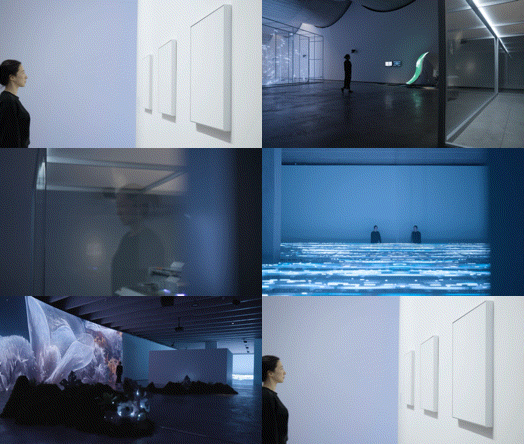


As visitors move through the exhibition, a perceptual journey unfolds from nature towards computation, and from computation back towards nature. As Jussi Parikka suggests in his conversation with Jiayu, the exhibition remains open-ended, extending beyond the gallery walls into the museum’s surrounding environment. Rather than offering a definitive conclusion, Still, Life invites visitors to carry its questions into the world outside, where the movements of air, light, matter, and living systems continue to unfold.
In this sense, the exhibition does not end at the museum’s boundaries but opens onto a wider landscape in which nature and computation remain in constant dialogue. It leaves us with a question that continues to shape Jiayu’s artistic research: when machines become another means of perceiving the world, how might we rethink not only nature, life, and intelligence, but also our understanding of the world we inhabit?

Academic and Research Support
Centre for Human–Machine Creativity, Goldsmiths, University of London
Quantum Optics Research Group, Australian National University
Leonardo Art Science Evening Rendezvous (LASER), USA
Design Curatorial Research Group, Central Academy of Fine Arts
Centre for Art and Technology, The University of Hong Kong
Biology Laboratory, Zhejiang Ocean University
New Media Art Foundation
Wang Shikuo Art Foundation
Technology Partners
Projection Equipment Support
XGIMI Professional Display
AI Model Development Support
Shihuan Industry
Spatial Design Support
KRETA
Supporting Organisations
Xi’an Shanhui Art and Culture Co., Ltd.
Beijing Yuanyi Ruibo Technology Co., Ltd.
Produced by
Beijing 798 Culture and Technology Co., Ltd.
Organised by
798CUBE
